
Australian Defence Force’s First-ever Competitive Parabiathlete
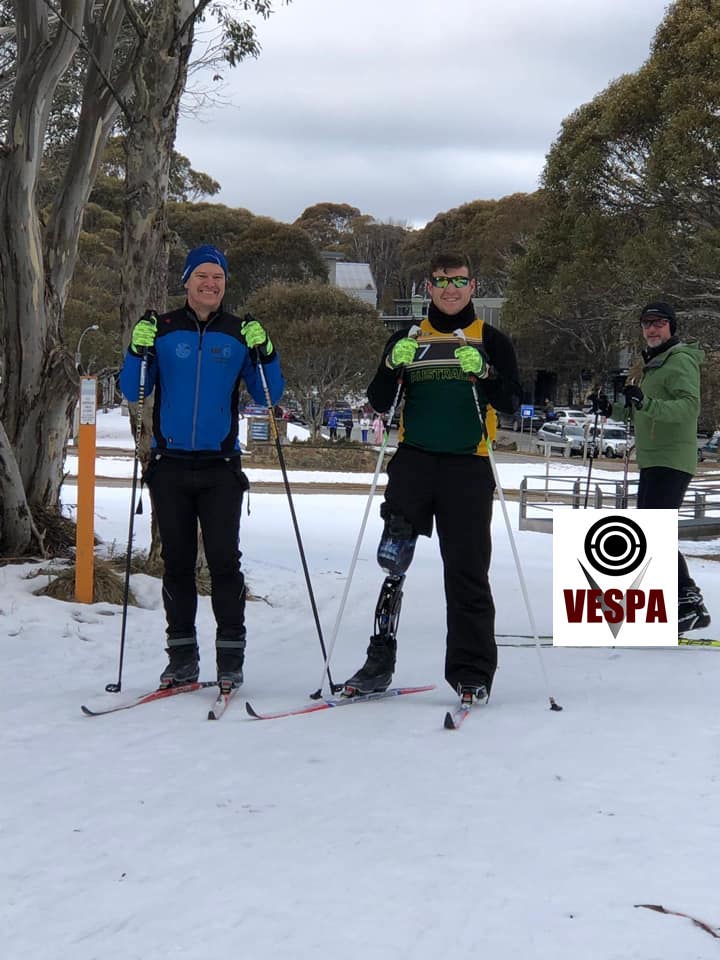
MIGHTY MARK HITS THE BIATHLON SLOPES…AND IS BANG ON TARGET!
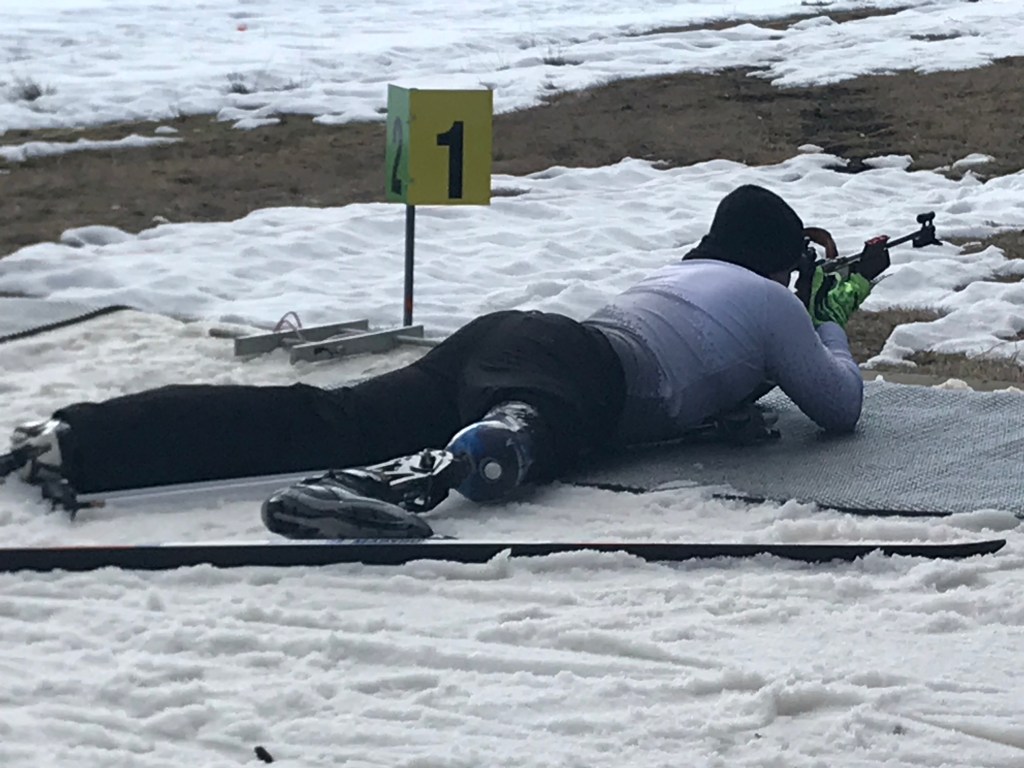
Ask most people about Biathlon and they’ll think you’re talking about something to do with a bike, and maybe swimming or running. Tell them that it is often considered the most difficult sport in the world to master, and they still probably won’t guess much closer. Biathlon is a Nordic Skiing sport, which involves protagonists skiing highly technical cross-country courses; on the sort of geography that will get your heart beating through your chest, just in time for you to have to stop, lie or stand perfectly still, then shoot five small targets from a distance of fifty metres, before doing it all again. Sometimes twice!
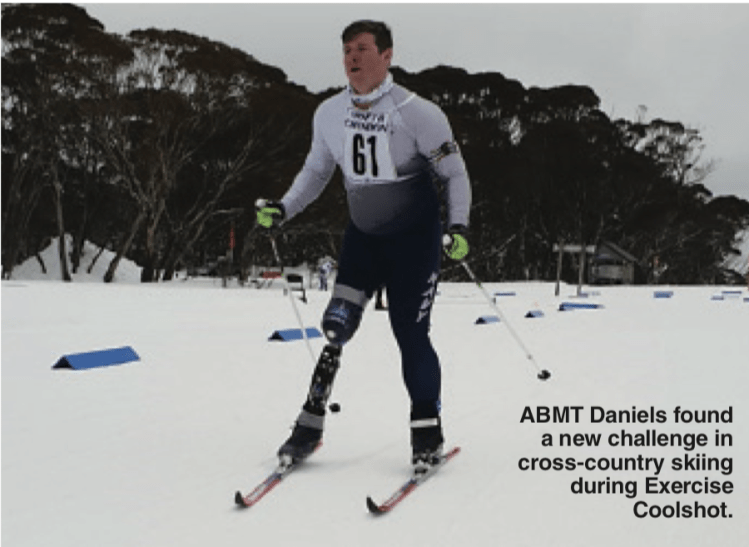
Anybody who saw Australian Ninja Warrior recently may know that AB Mark Daniels loves a challenge. Having endured an above-knee amputation, Mark’s career in the Royal Australian Navy is sadly coming to an end; but he is making sure he leaves in style. He has recently competed in the Invictus and Warrior Games, and was happy to answer the call from LCDR Gary Steiger, a member of the RAN Biathlon team, to take part in a proof of concept trial as the ADF’s first-ever Para-Biathlete, attending the ADF’s EXERCISE COOLSHOT, at Mount Hotham, Victoria.
Risk assessments and scoping for support completed by LCDR Steiger in the preceding months; generously funded by ADF Sport and Navy Sport, and with invaluable advice from GPCAPT Phillip Langworthy, (Director of ADF Sport) and LTCOL Christopher Leatham, (Director of ADF Adaptive Sports), the pair arrived at Dinner Plain with the rest of the Navy team in early August to take on the mountain.
[Mark became Australia’s first-ever parabiathlete to ski with a MkII limb]; LCDR Steiger adding; “Veterans who are forced to leave the ADF through injury often miss military life. Many of these veterans also need an outlet and love a challenge, and there is no more challenging sport than Biathlon, so I felt it was a great match; but finding a willing athlete was difficult. I ran The Road Home charity’s True Grit assault course with Mark in Adelaide, and I was massively impressed by his determination.”
On the slopes however, and like anybody else, AB Daniels found the going very tough; only a few hours into the first day of training, he complained of his frustration at how difficult he found the sport.
“I’m used to mastering anything I try within the first hour or two but this was different. For a start, they’re not like any skis I know; they’re stupidly narrow. I couldn’t believe how tough it was.”
Tough it may have been, but true to form, AB Daniels showed typically impressive grit; finding a way during the training week to get himself up, and more importantly, down the hills safely. LCDR Steiger skied with him as a coaching assistant and mentor for the entire training week, before setting his charge free in the competition phase of the exercise. “The man is immense,” his mentor commented, “…his upper body strength is matched only by an unbelievable determination to never be beaten and to at least match his ‘able-bodied’ counterparts.” This attitude proved a must to enable navigation of some serious slopes and turns in the heat of competition; Mark’s inability to use his prosthetic to control his descent meant making up some techniques as they went along, with fine-tuning by the Navy Coach, Warren Feakes. Control it he did however, with Mark not only finishing the Novice 5km Sprint, but also completing and performing admirably in both the Novices Relay and the exciting day/night event, the Super-sprint, including shooting 9/10 on the rifle range with his first effort; results he can be proud of as he prepares to transition from service.
Discussing recent findings from the Transition and Wellbeing Research Programme (Van Hooff, et al, 2018), LCDR Steiger briefed how the study found that transition is a very important time for veterans. “It can be a highly isolating period; where ones very identity can be challenged.” He further described how the research indicated that individuals who leave full-time ADF service are more likely to report poorer physical and mental health than those who remain. This can be attributed to a number of likely factors, including loss of social networks and difficulties re-establishing themselves in a civil environment that feels completely alien to them.
It is hoped that this venture will be the catalyst for a future therapeutic opportunity in the ADF Veteran, and the First-responder space, both in the winter format on snow and on roller-skis in summer with laser rifles; a venture which AB Daniels has shown keen interest to support.
“Biathlon can give such members a very military type of sport,” LCDR Steiger summarised, “which is highly challenging physically; much as members were challenged during their time in Service and with a similar camaraderie. Extended exposure to the sport brings new social opportunities in both an individual and team setting. It can bring rewarding expertise in a highly stimulating and natural environment, and can further provide a sense of achievement and mastery so important to veterans’ mental wellbeing, at a time when they feel anything but masterful in their new environment outside of the Services. We are in the very early stages but I have outstanding advisors from both within the ADF and externally, such as Elizabeth Burgess from the UK’s Armed Forces Para-snowsports Team (AFPST), and contacts like Luca Bormolini (Australia’s National Team Coach and ex-IBU World Cup Biathlete). I am looking to take this venture forward as a collaborative, therapeutic vehicle for those who have struggled since leaving the Services; for whatever reason. If we pick up a few superstars like Mark Daniels, then all the better!”
Both members thanked their sponsors, the Navy team President LCDR Garry Lewis, and the Navy Nordic Skiing and Biathlon Association (NNSBA), for allowing Mark to take part in EXERCISE COOLSHOT 19. Vision is now focussed on providing a platform for growing the adaptive version of the sport for Armed Forces Veterans and First-responders across Australia.
Reference:
Van Hooff M, Lawrence-Wood E, Hodson S, Sadler N, Benassi H, Hansen C, Grace B, Avery J, Searle A, Iannos M, Abraham M, Baur J, McFarlane A. (2018) Mental Health Prevalence, Mental Health and Wellbeing Transition Study, the Department of Defence and the Department of Veterans’ Affairs, Canberra.
This article was submitted to Navy News for publishing in September 2019. The abridged version, combined with an article for EXERCISE COOLSHOT 19 can be read via this link to the 5 September 2019 edition; https://www.defence.gov.au/Publications/NewsPapers/Navy/editions/6216.pdf
Photos:
- VESPA Parabiathlon (2019).
- Navy News (2019)
- VESPA Parabiathlon (2019).
 VETERANS AND EMERGENCY SERVICES PARABIATHLON AUSTRALIA