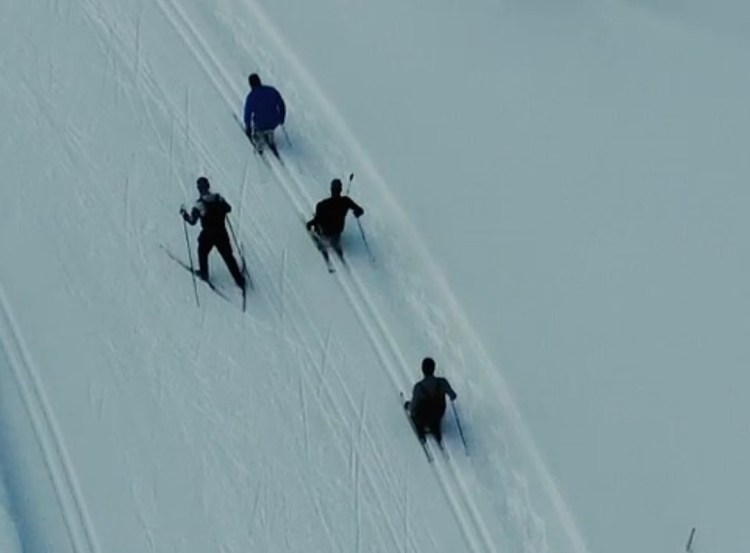
The word biathlon descends linguistically from Greece, the term meaning “two tests”. It requires a combination of the technique, endurance and strength (mental and physical) of cross-country skiing, alongthe fitness to recover quickly, to carry out precision rifle shooting. This presents biathletes with a hugely demanding physical and mental challenge; requiring all the tenets of cross-country skiing to be temporarily halted, the body steadied, to shoot with precision or face an extension of the final total distance required to be covered on skis or a penalty extension of their final finishing time.
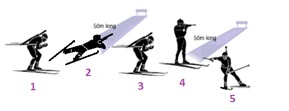
Longer events involve four shoots and skiing five circuits.
Basic concepts
Biathlon competition consists of a race, generally either against the clock (where athletes are started in individual stages) or in a mass start. Contestants ski a cross-country course, the total distance skied divided into either 2 or 4 shooting rounds; half in the prone position, the other half standing/unsupported. Dependant upon the shooting performance, extra distance is skied or time is added to the contestant’s total running distance/time, for each shot missed. The contestant with the shortest total time wins.
There are a few differences in the Parabiathlon world…
Skiing
Cross-country skiing is a form of skiing where athletes rely on their own locomotion move across snow-covered terrain, rather than using ski lifts or other forms of assistance. Cross-country skiing is widely practised as a sport and recreational activity; however, some still use it as a means of transportation. Variants of cross-country skiing are adapted to a range of terrain which spans unimproved, sometimes mountainous terrain to groomed courses that are specifically designed for the sport.
Modern cross-country skiing is similar to the original form of skiing, from which all skiing disciplines evolved, including alpine skiing, ski jumping and Telemark skiing. Skiers propel themselves either by striding forward (classic style) or side-to-side in a skating motion (skate skiing), aided by arms pushing on ski poles against the snow. Competitive cross-country skiing is one of the Nordic skiing sports. Cross-country skiing and rifle marksmanship are the two components of biathlon.
Skate-skiing technique only is permitted in the Parabiathlete stand-skiers, while in Nordic skiing, Classic technique is allowed but skate technique is usually preferred, being faster. No equipment other than skis and ski poles may be used to move along the track. The minimum ski length is the height of the skier less 4 centimetres (1.6 in).
Parabiathlon also has a Sit-ski classification, where most of the power comes from the poling action; though some athletes can also engage abdominals, depending on their injury.
Shooting
The biathlete carries a small-bore .22 calibre rifle, which weighs at least 3.5 kilograms excluding ammunition and magazines (or a laser rifle). The target range shooting distance is 50 metres (equivalent targetry is used with laser rifles). There are five circular targets to be hit in each shooting round.
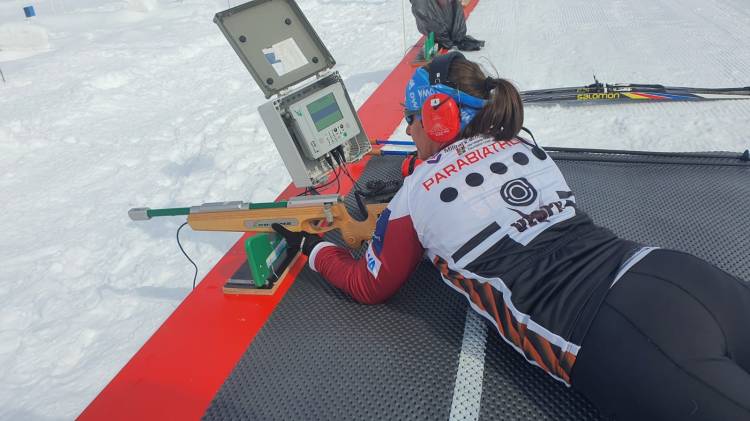
The parabiathlete uses an air rifle or a laser rifle in competition. Visually impaired athletes use a sonic targeting system on a laser rifle, where a changing pitch tells when the rifle is on target.
Target size
Prone position – 45 mm (1.8 in) diameter
Standing position – 115 mm (4.5 in) diameter
In parabiathlon, only prone shooting is used competitively. Athletes are handed their rifle once on the shooting mat.
On all modern biathlon ranges, the targets are self-indicating, in that they flip from black to white when hit, giving the biathlete, as well as the spectators, instant visual feedback for each shot fired.
VI athletes have a sound indication, while a light indicator tells judges and spectators whether the target has been hit.
Targets may be engaged in any order.
For each shooting round, the biathlete must hit five targets and receives a penalty for each missed target, which varies according to the type of race, as follows:
- Skiing around a penalty loop (normally around 100-150m), typically taking 20–30 seconds for elite biathletes to complete, depending on weather and snow conditions; or
- Adding one minute to the skier’s total time; or
- Use of an extra cartridge (placed at the shooting range) to hit the target; only three such extras are available for each round, and a penalty loop must be done for each target left standing.
Once all the shoots and, if necessary, penalty loops are complete, the biathlete has to complete one more lap at best possible speed.
DOES THAT NOT SOUND LIKE THE BEST SPORT IN THE WORLD?
YOU’RE RIGHT; IT IS!
Adapted from ADF Biathlon description of the sport.
 VETERANS AND EMERGENCY SERVICES PARABIATHLON AUSTRALIA